Differentiated Key-Value Storage Management for Balanced I/O Performance
DiffKV, a novel LSM-tree KV store that aims for balanced performance in writes, reads, and scans.
Intro
Key-value storage three main operations
-
writes, insert KV pairs
-
reads, retrieve the value of a single key
-
scans, retrieve the values over a key range
Efficiency of sequential I/Os && Data ordering for fast scans ---> Log-Structured-Merge-tree,
but suffer from high write and read amplifications.

Simple discription of LSM-tree storage structure
-
It stores KV pairs in entirety as multiple disk files, called SSTables, in multiple levels.
-
Two in-memory write buffers, MemTable, Immutable MemTable.
-
Flushing the Immutable MemTable to level L0 on disk with append-only writes.
-
All KV pairs in each of the levels from L1 to Ln are fully sorted by keys for fast scans.
L0 are unsorted across different SSTables for fast flushed.
(在L1至Ln的每一层中KV对都是按键全排序的;L0不保证SSTable之间的顺序, 但每个SSTable内部仍是有序的)
Write process
KV pair ---> MemTable --full-> Immutable MemTable    (in-memory)
----------------------------------------|------------------------
                                        |            (out of memory)
                                    L0 SSTable
                                        |
                                  n----full?----y---
                                                   | Compaction
                                               L1 SSTable
                                                    |
                                                  full?
                                                   ...
How to compact a SSTable S in Li into Li+1?
The KV store reads S and all SSTables in Li+1 that have overlapped key ranges with S,
then sorts all KV pairs by keys and creates new SSTables, then writes back into Li+1.
Read process
First, search in memory, not hit, then performs binary search in each level of the LSM-tree,
from L0 to Ln. 在每一层,使用Bloom filter 查看是否存在该KV pair.
Motivation
Two directions of LSM-tree optimization
-
Relax the fully-sorted nature in each level of the LSM-tree.
E.g. PebblesDB --- a fragmented LSM-tree
使用guards将每层划分为几个不相交的groups. 同一group下的SSTables中的键范围可能重叠。
将Li层中的一个组中的SSTables压缩至Li+1, 仅读取相应组中的SSTables,排序并存至Li+1,
不需读取Li+1层的与之有重叠的内容. 大大减轻了compaction overhead.
However, Sacrificing scan performance. (针对不同groups并行发射读—更多CPU资源消耗、有限提升)
-
KV separation
Keeping only keys in fully-sorted ordering in the LSM tree and performing value management in a dedicated storage area.
pros: LSM-tree size decreases, suited for large-size values KV workloads.
cons: For small-to-medium size values, degrades the scan performance. (Cause values over a key range are no longer fully sorted);
incurs extra garbage collection overhead.
可能的优化:
-
键和值的有序程度(the degrees of ordering in keys and values). fully sorted/ partially sorted/ unsorted.
-
针对不同大小的KV对的管理(KV pair: ..., large, medium, small, ...)
Methodology
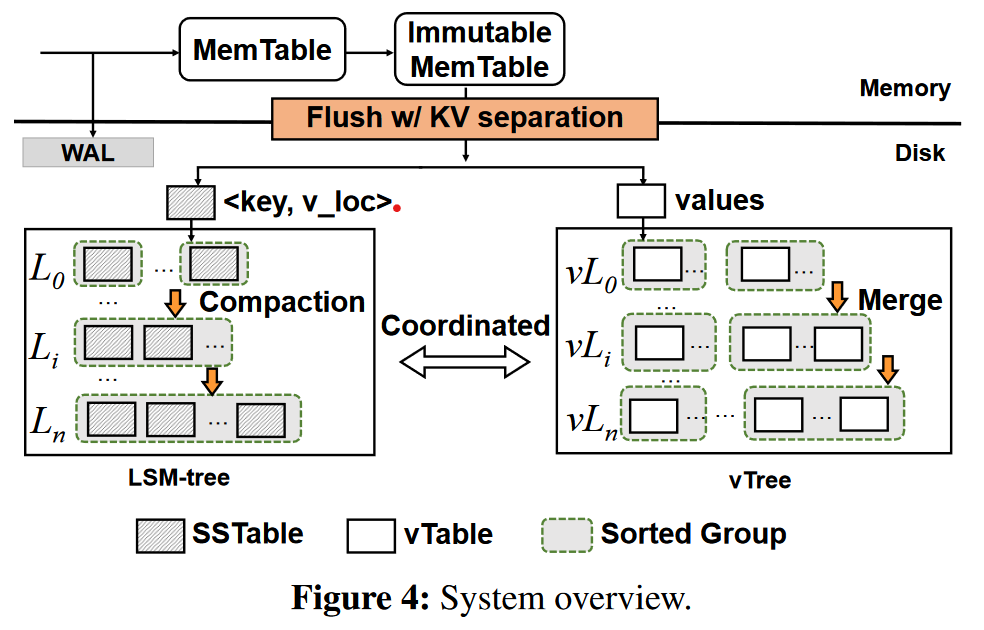
DiffKV (区分的KV管理,既蕴含Key和Value的分离管理有序程度,又包含针对不同大小KV对的管理)
Two main ideas:
-
Carefully coordinate the differentiated management of the ordering for keys and values.
-
LSM-tree for <key, v_loc>, fully sorted
-
vTree for value management, partially-sorted values coordinate with respect to ordering of keys
Sorting of valuees in the vTree is triggered by the compaction of the LSM-tree.
-
-
Fine-grained KV separation, maintaining balanced performance under mixed workloads (KV pairs of different size groups)
Features
vTable, DiffKV organizes values as fixed size vTables. composed of:
-
data area, values of KV pairs in a sorted order based on their keys
-
metadata area, e.g. data size of vTable / smallest and largest keys of the values
Sorted group, a collection of vTables. The key ranges of any two vTables in a sorted group have no overlaps.
In DiffKV, all vTables generated in one flush form a sorted group,
use the number of sorted groups is an indicator of the degree of ordering in the vTree.(以vTree中有序组的个数来指示有序程度)
vTree
|                    vL0                    ]
|[***sg1]..[***sg8]  vL1     -- level       ]
...                                         ] vtree
|                    vLn                    ]


// vtree consists of levels
   level consists of sorted groups (not necessarily sorted)
   sorted group consists of vTables
   vTable consist of values
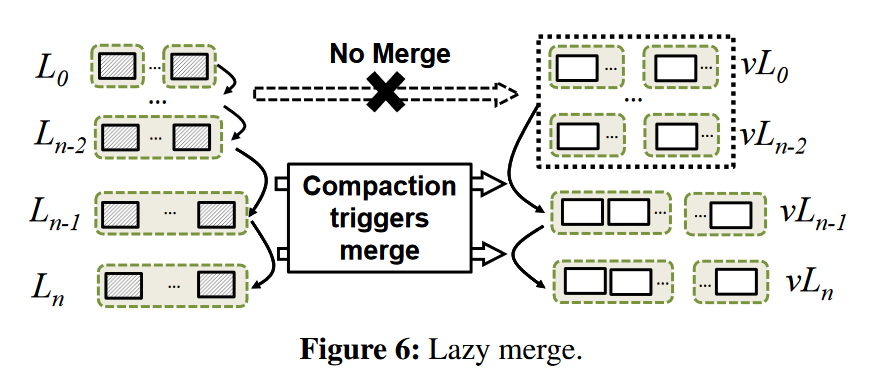
Merge operations are used to keep partially-sorted ordering for values which was triggered by
compaction operations in the LSM-tree in a coordinated manner. --- compaction-triggered merge
Two benefits from ctm:
-
efficient to identify valid values;
-
reduce overhead needed to maintain the latest value locations.
Further Merge Optimizations
每个compaction一个merge,太多了。
- Lazy merge, 将vL0,...,vLn-2视作a single level,任何来自L0,...,Ln-2的压缩不会引发归并,
除非值需要归并到vLn-1.
-
Scan-optimized merge
找出与许多其他vtables有重叠键范围的vtable,使之参与合并过程,增加vTree中值的有序度。
垃圾回收
回收无效值所占用的空间(在LSM-tree中,通过压缩回收无效值)
小优化:state awareness, Lazy GC 降低垃圾回收开销
细粒度的KV分离
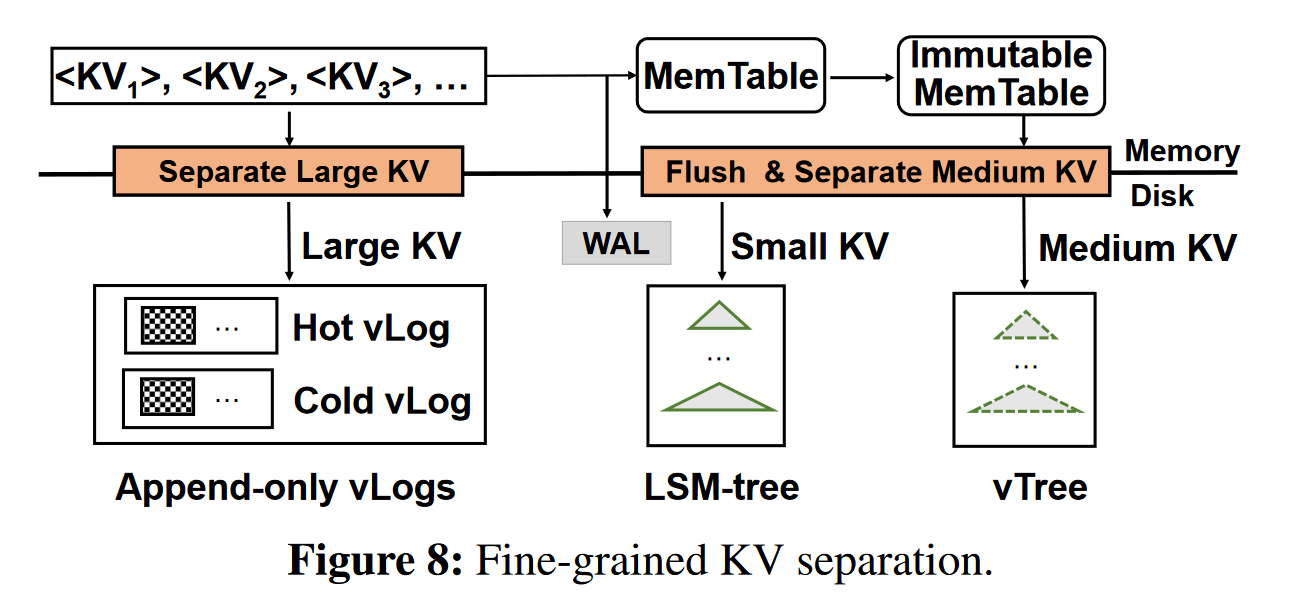
根据值的大小分为large, medium, small
-
large KV pairs, 采用hotness-aware multi-log(vLogs)
-
medium, values in vTree, <key, v_loc> in LSM-tree
-
small, no KV separation, all in LSM-tree
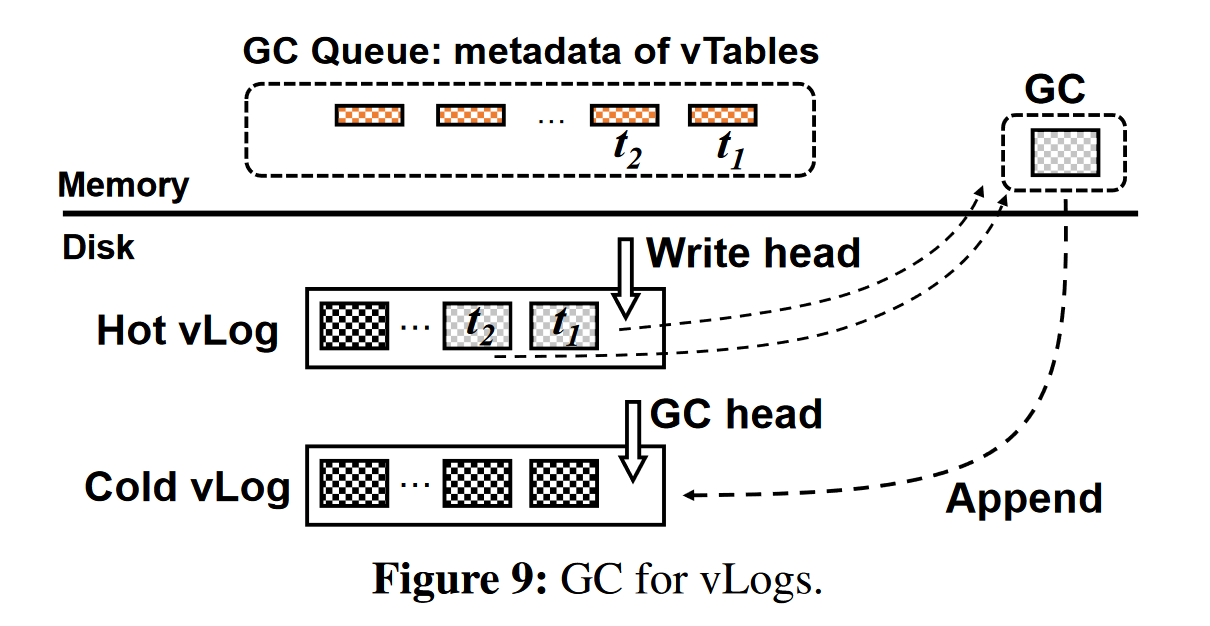
vLog: 被设计成一个简单的循环append-only log,它由一组未排序的vtable组成。
热感知 vLogs: Hot vLog (Write head), Cold vLog(GC head)